
Why Your Body Clock Matters for Blood Sugar, Blood Pressure, and Heart Health
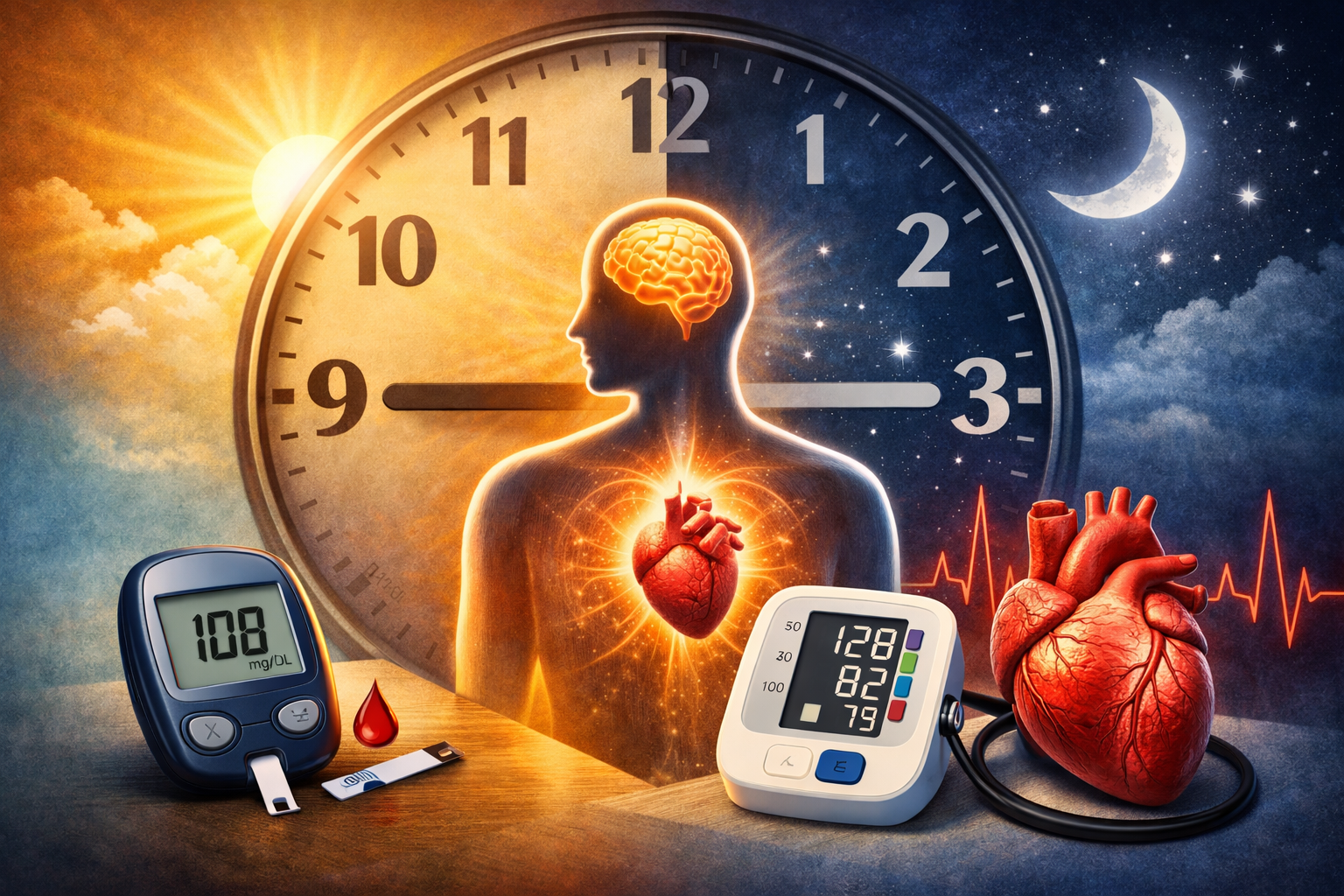
Insights from the American Heart Association Scientific Statement in Circulation on circadian health and cardiometabolic disease risk.
Most people think about cardiometabolic health in terms of what kinds of things we eat, how much we exercise, and how well we sleep. Increasingly, high-quality evidence suggests we should add a fourth question:
When are these behaviors happening relative to our internal body clock?
To my surprise, in December of 2025, the American Heart Association (AHA) published a Scientific Statement in Circulation summarizing how circadian health—our internal 24-hour rhythmic biology—relates to cardiometabolic outcomes such as obesity, type 2 diabetes, hypertension, and cardiovascular disease.
Let’s break down some of these topics so you can apply these concepts to your current lifestyle.
1) What is circadian rhythm and “circadian health”?
Your circadian rhythm is your body’s built-in timekeeping system that coordinates near-24-hour rhythms in physiology and behavior—sleep/wake patterns, hormone release, digestion, body temperature, blood pressure, and metabolism.
The AHA highlights that this system includes a central clock in the brain (hypothalamus) and peripheral clocks throughout the body, including liver, pancreas, muscle, fat, and blood vessels. Traditional Chinese Medicine has long practiced this concept. These clocks coordinate cardiovascular and metabolic function across the day.
The AHA defines circadian health as the optimal function, rhythmicity, and alignment of internal circadian rhythms with each other and with the external light and dark cycle.
Key point: circadian health is much more than how much you sleep—it includes timing of light exposure, meals, sleep, and physical activity.
2) Why we become less insulin sensitive later in the day—and why late eating can backfire
A consistent finding in human research is that glucose tolerance tends to be worse later in the day, meaning the body generally handles carbohydrates more efficiently earlier than later. This is driven in part by circadian effects on insulin sensitivity and insulin secretion.
In controlled studies, the cellular circadian system contributes to reduced glucose tolerance in the biological evening compared with the morning. Who knew this?
What does that mean clinically?
If someone eats most of their calories late—especially refined carbs or ultra-processed foods—there may be a greater likelihood of higher post-meal glucose, more prolonged elevations, and poorer metabolic signaling than the same meal earlier in the day. There will always be individual variability, but overall the science is showing this.
The AHA Scientific Statement emphasizes that meal timing affects metabolic health beyond calories and that eating late or having irregular mealtimes can misalign peripheral clocks in organs like the liver and pancreas, contributing to blood sugar instability and weight gain.
The AHA summary also notes that later timing of meals tends to be associated with worse cardiometabolic outcomes, including diabetes, high blood pressure, and cardiovascular disease.
3) Comorbidities linked with circadian disruption
As you just read, circadian disruption isn’t just a “sleep issue.” The AHA statement and related summaries highlight associations between circadian disruption and increased risk of:
Obesity / excess weight
Type 2 diabetes and glycemic dysregulation
Hypertension / high blood pressure
Cardiovascular disease
A major real-world driver is shift work, especially rotating/night schedules, which the AHA notes is commonly associated with higher risk of obesity, diabetes, hypertension, and cardiovascular disease.
Practical takeaway: Time-Restricted Eating (TRE) as a “circadian-alignment tool”
Time-restricted eating can be approached as a timing strategy rather than a willpower test. The goal is to consolidate eating into a consistent daily window—ideally earlier—to better match metabolic circadian rhythms.
Evidence suggests “early” TRE, earlier eating window may offer metabolic advantages in some populations, including improvements in insulin sensitivity and cardiometabolic markers in controlled trials.
Practical tips you can share with patients (simple, actionable)
Choose a consistent eating window most days (often 10–12 hours is a realistic starting point).
Front-load calories earlier when possible; avoid making dinner the day’s largest meal. (This aligns with AHA messaging that meal timing matters beyond calories.)
Aim to finish eating 2–3 hours before bed to reduce late-night metabolic and sleep disruption.
Start with dinner timing first: move dinner earlier by 30–60 minutes for 1–2 weeks before changing breakfast.
Protect the light–dark cycle: morning outdoor light + dimmer evenings supports the central clock (which helps anchor sleep and downstream metabolic rhythms).
If you’re a shift worker: focus on reducing circadian misalignment—regularity, strategically timed meals, and minimizing bright light at night become even more important.
Important clinical note: TRE is not appropriate for everyone (e.g., certain pregnancy/lactation scenarios, eating disorder history, some diabetes medication regimens). Individualize and coordinate with the care team as needed.
Circadian health is a missing layer in many cardiometabolic conversations. The AHA Scientific Statement makes it clear: timing is a modifiable health behavior—alongside food quality, movement, and sleep.
If you’re experimenting with time-restricted eating, consider starting with one powerful shift: eat earlier and more consistently.